

- Who We Are
- Our Work
- Who We Are
- Our Work
Geographic Information System
About The GIS
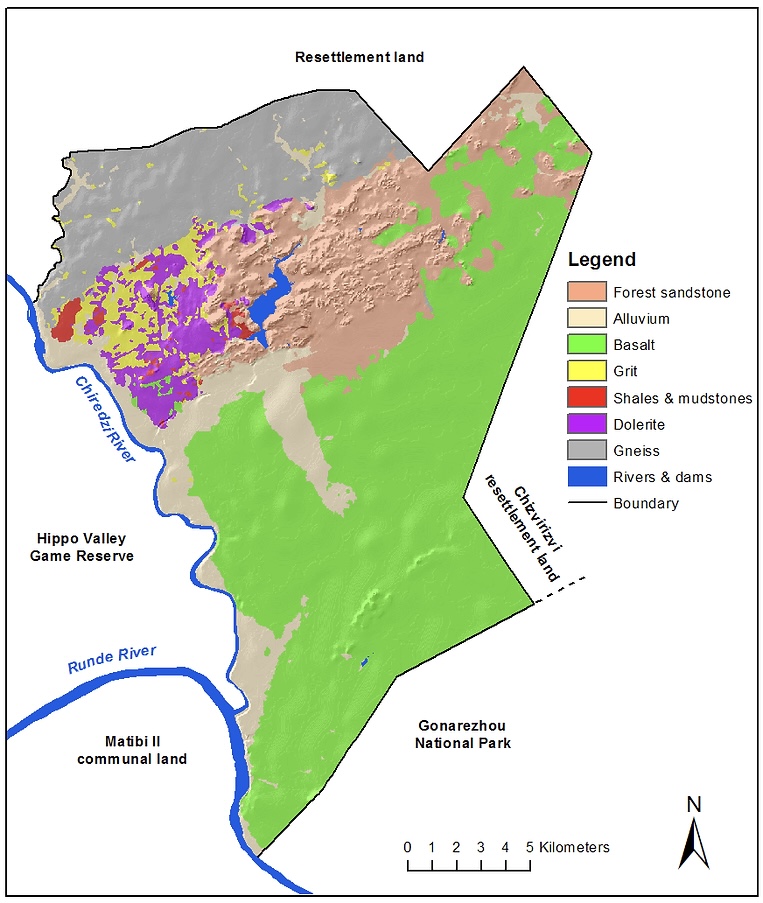
Between 2000 and 2003, as part of a PhD study, we mapped the physical attributes of the reserve and discovered that Malilangwe is remarkably diverse for its size. Seven different geological substrates give rise to a wide range of soils, which in turn support 38 distinct vegetation types. To capture and manage this information, we utilize a Geographic Information System (GIS). Using the GIS, we are able to map elevation, slope, geology, soils, vegetation, drainage networks, fires, and man-made infrastructure across the reserve.
GIS’s Role at Malilangwe
Because the underlying geological features of the reserve change very little over time, the physical attribute dataset we recorded in the early 2000s have not required re-mapping. Vegetation, however, is far more dynamic, and we have periodically utilized the GIS to update the vegetation maps, reflecting changes in shrub and tree canopy volume.
Most recently, as part of a MSc study on soils and grasses, we utilized the GIS in combination with daily rainfall data from 22 gauges across the reserve to calculate and map daily soil moisture content over the past 20 years, further expanding the system’s value as a management and research tool.
Today, the GIS plays a central role in many aspects of reserve management, including:
- Planning prescribed burns
- Deciding where to clear encroaching bush
- Understanding the factors that influence the distribution of vegetation & wildlife
- Planning road networks, and
- Monitoring off-road driving by vehicles

- Our Work
- Our Work